In this studio paper students will establish a critical position through individual or collaborative creative exploration and articulation. With opportunities for varied contextual applications, students will consolidate and expand spatial design concepts, techniques, skills and processes in the production of their creative work.
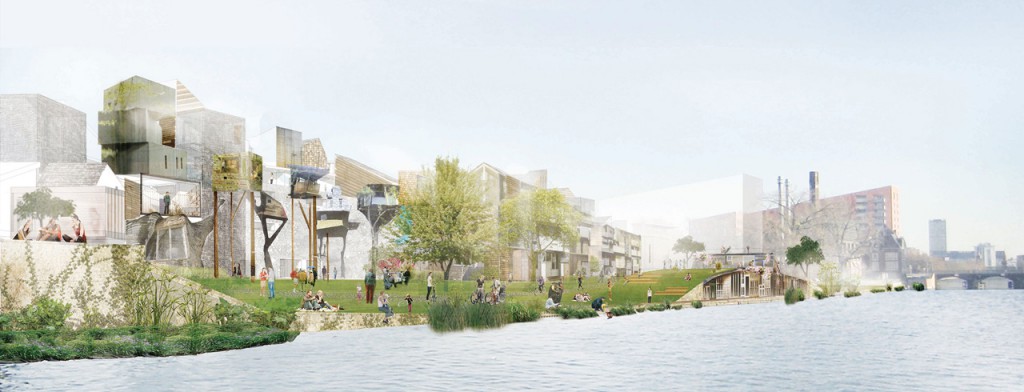
tautoko: performing on uncommon ground
The core aim of this assignment is to begin to understand and develop your own individual practice and critical perspective as an emerging designer in relation to a selected area of interest. The vehicle for this will be a live competition brief, within which you will negotiate your own agenda, or kaupapa.
Tautoko is to demonstrate support or advocate for, and implies a level of consensus, however this goes beyond simplistic notions of support. Tautoko can be used as a means to define/refine exactly what it is you or your group is offering its support to – in this way it includes the negotiation of positions.
Project Brief
“[An] alternative kind of place in a state of transition… the centre of the neighbourhood – physically and spiritually; the market, the creative village, the club and the restaurant invite, surprise and entertain. Artists, artisans, musicians and hedonists create with and for each other” (Holzmarkt, 2015).
The Holzmarkt, or Timber Market – an urban community initiative to revitalise what was once ‘no mans land’ on the boundary between East and West Berlin – is the mooring-site for a temporary performance platform. The OISTAT Theatre Architecture Competition 2015 brief challenges entrants to develop a design proposal for a temporary floating theatre on the River Spree in Berlin, Germany. Along with meeting key requirements, competitors are asked to respond to a specific performance concept of their own selection/invention.
“Kaupapa means principles and ideas which act as a base or foundation for action. A kaupapa is a set of values, principles and plans which people have agreed on as a foundation for their actions.” (Te Ahukaramū Charles Royal, 2015).
This project will be driven by the requirements of twin briefs: that of the OISTAT TAC, and 224.357 Performing on unCommon Ground. While each of these briefs has its own kaupapa, tying together these twin hulls will be a kaupapa, or platform/stage, of your own choosing – an agenda or issue about which you are passionate; a cause or community for which you wish to tautoko – around which you can formulate a critical response and a foundation for honing your unique creative practice.
References
Holzmarkt. (2015). About Us. Holzmarkt. Retrieved from www.holzmarkt.com/uber-uns/?lang=en
Te Ahukaramū Charles Royal. (2015). Papatūānuku – the land – Whakapapa and kaupapa. Te Ara – the Encyclopedia of New Zealand. Retrieved from www.TeAra.govt.nz/en/papatuanuku-the-land/page-8
Submission Requirements
Competition entry as per OISTAT TAC 2015 requirements – submitted digitally
Prototypes and development work digitally documented in progress blog
Reflection document – submitted as PDF to Stream
Learning Outcomes & Assessment Criteria
Establish a critically informed position that contextualises your creative work (Matauranga – Understanding)
Demonstrates understanding of tautoko and kaupapa.
Translates a critically performed position into a clear and compelling performance concept.
Articulates this concept through the submitted work and written statement.
Articulate a clear strategy that enables the realisation of defined goals (Creativity – Toi )
Successfully negotiates and interprets the twin briefs.
Establishes and meets clear deadlines and deliverables.
Delivers a design outcome that meets the requirements of the briefs and is true to the established kaupapa.
Show command of your creative process to address project challenges (Creativity – Toi)
Shows evidence of development of design process.
Explores a range of media and techniques; employs processes and methods of presentation appropriate to the design concept.
Displays high level of craft, quality and refinement in final proposal.
Resources
- OISTAT TAC 2015 Design Brief
- OISTAT TAC 2015 website
- OISTAT TAC 2015 Location Plan
- OISTAT TAC 2015 Site Photos
Schedule & Further Info
224.357 Spatial Design Studio III
#spatial3 blogs: goo.gl/forms/pfi5pYPa8S
Submit blog form: goo.gl/forms/pfi5pYPa8S
WEEK ONE _ SESSION ONE
introduction.interpretation
what?
We will introduce the twin briefs for this project – 224.357 Performing on Uncommon Ground and the OISTAT Theatre Architecture Competition (TAC) 2015. You will then begin work to interpret these briefs and the project requirements.
how?
Deconstructing and reconstructing the briefs using key words, mapping and diagramming techniques, peer discussion and individual reflection.
why?
There is a lot to digest from the briefs, and at first glance the project will appear quite complex. However, once you break it down and pull out the key concepts, aims and deliverables, it is easier to form a simplified picture of both the project as a whole and the projected workflow.
WEEK ONE _ SESSION TWO
site.synthesis
what/how?
Discuss and synthesise responses to brief.
Panel discussion about site (River Spree, Berlin, Holzmarkt) and creative process with guest speakers Nick Kapica, Hans Kellet, and Uli Thie.
why?
Mapping a clear overview of the brief, orientating/locating yourself, planning a route/trajectory/process.
FURTHER INFORMATION:
[links from Nick Kapica]
www.arena.berlin/portfolio/badeschiff/
www.icloud.com/photostream/#AAJ0DiRHJfU3bn
docs.google.com/presentation/d/1SXKaC_4nRM5WwweFjSREg9kmiagx3hxH5AJFq8Ma_HY/edit?usp=sharing
(watch video in last slide)
[more from Hans]
see Jen for copy of essay about cultural politics in relation to site (in German, needs translating!)
WEEK TWO _ SESSIONS ONE & TWO
drawing out your kaupapa
what?
Workshopping and developing your kaupapa / initial design response.
Panel discussion around tautoko, kaupapa, and waka hourua with guests Erna Strachl and Kura Puke.
how?
One-on-one and peer discussion/critique. Making-in-response (drawing, modelling, testing).
why?
Your design response should begin to emerge from an iterative process of making and reflection, in response to the brief, site, and your own individual motivation/agenda (kaupapa). This process is akin to a ‘drawing-out’ – a focussing of the field of infinite possibilities that already exist – utilising both talking-about and thinking-through-drawing/making as tools to facilitate the emergence of your core kaupapa and performance concept.
Tautoko (support/advocacy), hei puna tautoko (wellspring/source of support), and kaupapa (agenda/platform) should by now be becoming embedded concepts in your thinking about this project and your method of response to the briefs. Alongside this, the waka hourua (twin-hulled waka/canoe) has been introduced as both precedent/inspiration as a floating stage or platform, and a metaphor for the project, with the twin briefs as the vehicles that carry you across the seas, and your kaupapa as the platform that both binds them and supports the mast and sail – that which captures the wind or motivation that moves/pulls your project forward.
The Pacific Voyagers. (2012). Our Blue Canoe
. Retrieved from: pacificvoyagers.org/videos/
deliverables for week three _ session one:
– 2 minute (maximum!) presentation of kaupapa and initial design response / performance concept
– medium of your choice (powerpoint, video, physical 2D/3D material)
– please prepare and rehearse your presentation to offer as much insight as possible into your work-in-progress within the time limit
– the aim of this presentation is to share your work-in-progress with your peers and to give and receive critical feedback
– you will each provide written critical feedback to the people who present before and after you, as well as receiving feedback from Jen & Meg
– please ensure that all work is ready for presentation (pinned up / loaded onto the computer) before 9am Thursday
WEEK THREE _ SESSION ONE
interim presentation
Well done everyone on your presentations! Please upload your peer feedback to the google doc.
WEEK THREE _ SESSION TWO
design development & strategy
One-on-one meetings with Meg & Jen.
Map out your design strategy, including timeline and deliverables, working backwards from the Week 5 deadline. Post this on your blog and use it to keep yourself on track over the next 2 weeks!
WEEK FOUR _ SESSION ONE
design development
One-on-one meetings with Meg & Jen.
A few notes of reassurance…
Some of you will be feeling a bit anxious about this project and how you are progressing with it. I just want to offer a few words of reassurance. It is normal to feel this way and you are not the only one! This is a HARD project, for a number of reasons:
- There is a lot of information to synthesise between the two briefs before you even start ‘designing’. In terms of meeting all the criteria, do the best you can, but think of these as guidelines rather than hard and fast ‘rules’ – if you need to ‘interpret’ these (ie bend the rules a bit) to fit your project, then go for it. You might not hit every one of these points – capture as much of it as you can and then ‘sell’ what you’ve come up with to us, through both the written justification and the power of the visuals.
- The final output for this project is different from what you might be used to. You are not being asked to present a fully resolved and detailed design proposal. Rather, this is an initial design idea or concept. You are allowed to ‘fake it’ a bit – you don’t need to understand how every bit of it works. You will give us an overview of the design concept through the plan and section, and then suggest moments of the experience through the visuals. Give us enough to ‘hook us’, but leave some room for us to fill in the gaps. Hand sketches and ‘unfinished’ drawings can sometimes say more than photorealistic renders.
- The design process may be different from how you have worked before. It is less ‘scripted’ or structured, more open to interpretation, and there is more expectation on you to drive your own project and to develop and trust your own instincts. There is more emphasis on conceptual development and the power of poetic and meaningful gestures. This means that rather than a ‘right or wrong’ answer, the work is successful if it emotionally resonates with both you, the designer, and us, the viewers.
- You are working with media and methods that may be unfamiliar. Many of you are used to working in Sketchup, especially once you are ready to ‘model’ your design and then create renders. This may or may not be the best method for this project, particularly as you do not need to submit a digital model, and may not have time to fully resolve all aspects of the 3D form. There can be a tendency with Sketchup to look at the design/structure as an ‘object’ rather than designing from the ‘inside out’ – starting from the experience. We encourage you to utilise digital modelling only if and when it is helpful, and consider this as one of many available tools. When you are designing an experience rather than an object, you need to find design methods and media that allow you to explore the less tangible qualities of space – mood, emotion, atmosphere, movement, sensory phenomena – and to consider the temporal programme (unfolding of events through time) rather than just the spatial form. You may find ‘looser’ media such as watercolour or charcoal, light-based media such as photography, or time-based media such as video helpful as tools for design development, which can also be (re)worked into evocative images for presentation. This is another important point – your development sketches/drawings may even become your presentation images…!
To sum up, none of the challenges you are facing right now are unintentional – this first project of your 3rd year is meant to push you beyond your comfort zone, and encourage you to explore and develop your own personal processes, methods, and points of view. You have all made it to this point both because you are capable already, and because you possess the potential and desire for further growth. It is fantastic to see you stepping up to this challenge. We know you will learn from the experience, and produce work that might even surprise yourselves – and us!
Keep it up, be fearless, and embrace the fact that you are an artist with something to say!
And remember that Meg and I are here to support – tautoko – you too.
– from Jen
WEEK FOUR _ SESSION TWO
visual representation
please print out and bring to the studio session:
- examples/precedents of the kinds of visual representation that you will be including on your A0 competition boards:
- site plan
- floor plan(s)
- section(s)
- perspectives/views
- diagrams of different configurations / change over time / use of space
Last modified: February 22, 2021