In this course you will explore
research methods, processes and practices
for Spatial Design and their application,
through a research project
chosen and developed by you,
working between the practice of making
and critical writing as a method of research.
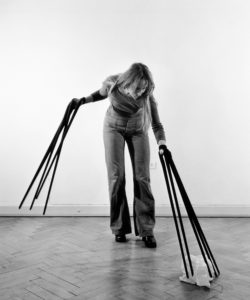
Rebecca Horn, Finger Gloves, 1972
_
Whakatinana
Tinana refers to the actual, main part or core of something, including the self. Whakatinana is to make manifest concepts or ideas, to be able to realize your individual or collective aspirations in tangible form. This concept recognises that the process of actualisation is connected both to an individual’s or group’s aspirations and the framework or structures (social, political, cultural, historical) within which they operate. As a process, whakatinana respects that there will be challenges in the world and that every challenge should be taken seriously and planned for with due caution. Accepting challenges and acknowledging the importance of your support structures, including valuing the contribution of others and thorough preparation, fosters mutual respect.
thinking-through-making
Spatial Design Research & Development is an intensive research-oriented paper which integrates theoretical investigations and design experiments, through a reflexive process of embodied thinking as doing (Grosz, 2001).
“[This] project […] is in part about thinking, about how to think, to think while making or rather while doing: to think as doing.”
Elizabeth Grosz, 2001, pp. 57-62 .
Architecture from the Outside: Essays on Virtual and Real Space.
Cambridge & London: MIT Press.
“Thinking-through-making is a process in which making and thinking alternate back and forth all the time, in rapid iterations. The making or designing could be taking place intuitively. Reflecting on what has been made helps create knowledge and insights.”
Bas Raijmakers & Danielle Arets (Eds.), 2015, p.14.
Strategic creativity series: Thinking through making.
Eindhoven, The Netherlands: Design Academy Eindhoven.
Week 1
Monday session:
- welcome/intro to fourth year studio
- intro to course/brief
- exercise: analysing examples of spatial design R&D projects and extracting:
- concerns
- spatiotemporal variables (see whiteboard below)
- thinking-through-making strategies
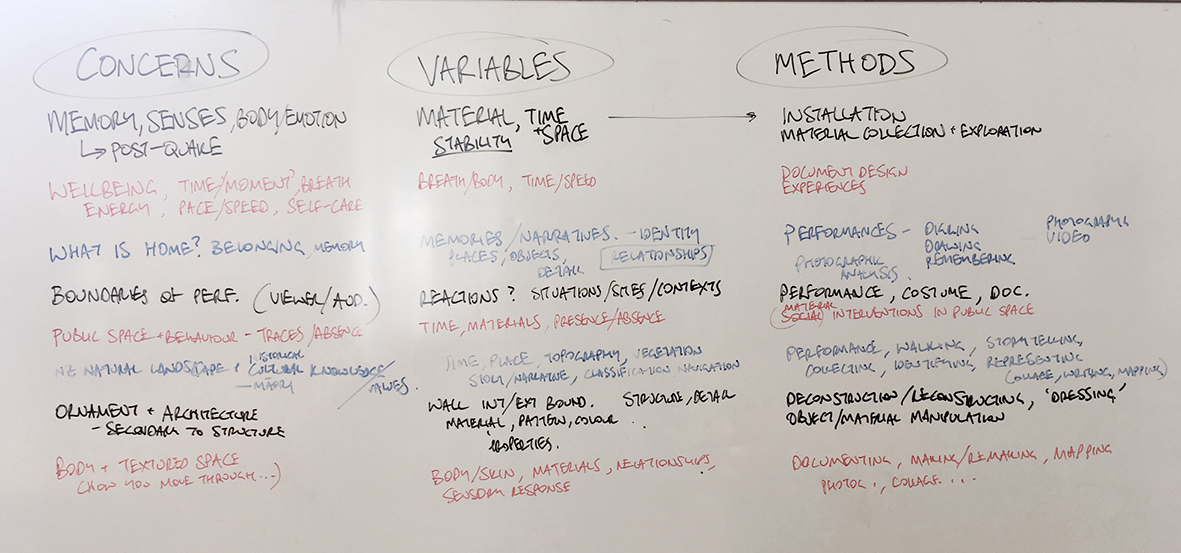
Whiteboard from Monday 26 Feb 2018: concerns, spatiotemporal variables from analysis of past research projects
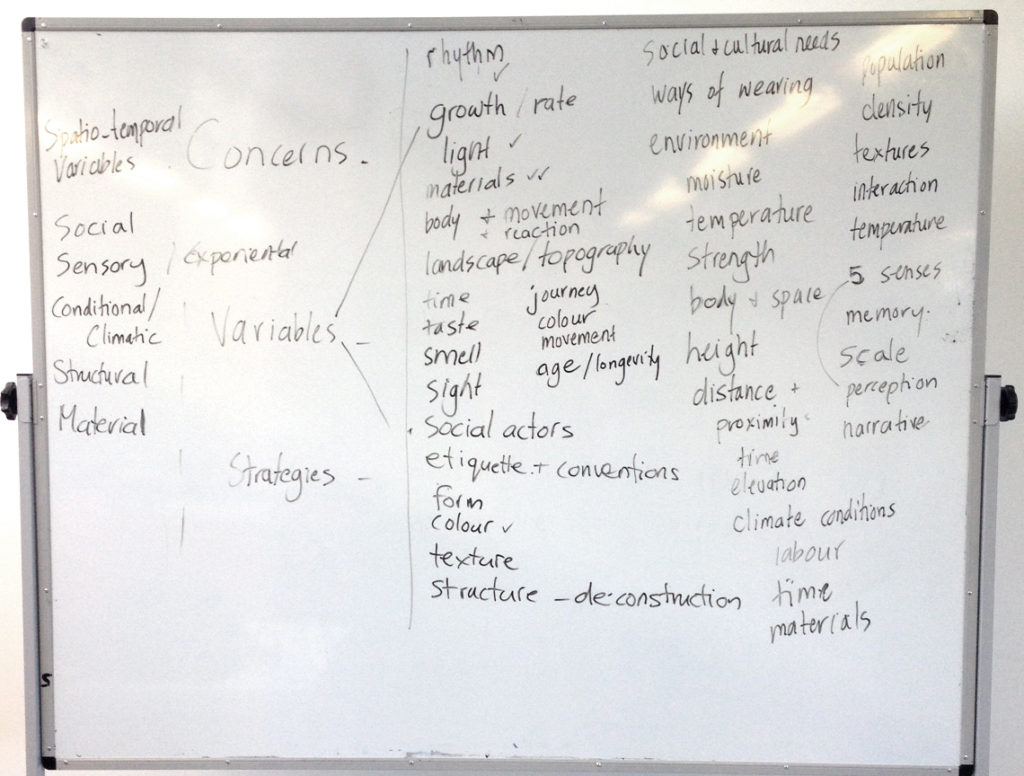
Whiteboard from Monday 27 Feb 2017: spatiotemporal variables from analysis of past research projects
For Friday:
- set up blog and fill out blog form
- make a first blog post as a reflection on the first session – what initial insights/thoughts do you have about what ‘spatial design research’ might mean/be for you (#thoughts #wk1)
- gather visual/material (hard copy) examples of your work over the past few years, plus any key images of particular areas of interest or concern; MAKE a ‘visual map’ or assemblage of this collection of images (document on blog #experiment #wk1)
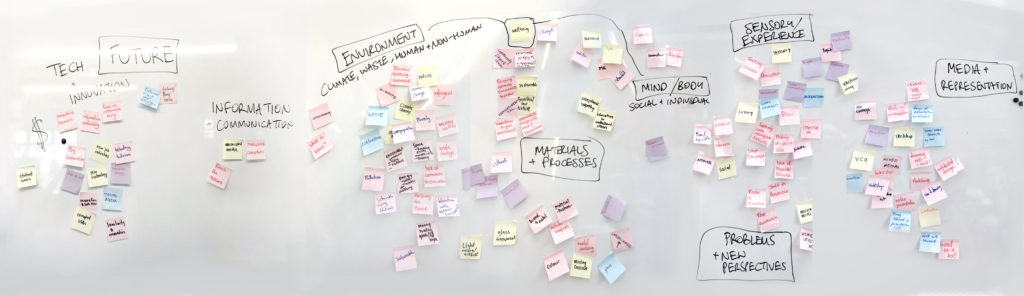
Possible research areas / areas of concern: post-it exercise from Nov. 2016 workshop led by Jen
Friday session:
- ‘tabling’ of Week 1 gathering/making
- exercises to draw out ‘concerns’
- start to form clusters of common concerns in order to ‘situate’ your research
Initial clusters from Week 1:
-
experience: immersive mixed reality experiences
Rosie, Emma, Georgina, Holly D
-
material: material and object driven atmospheres, constructing culture/identity
Libby, Lauren, Kendra, Holly S, Jei, Portia
-
journey: navigation, journey, narrative, change, transition, temporal, liminality
Claire, Ellie
-
aesthetics: aesthetics, material, form, identity/politics
Bryn, Ryan, Hennessey, Josiah, Georgia, Candeece
-
place: site, place, landscape
Hannah, Georgia, Sammy
-
behaviour: human behaviour, systems, function, program
Sophie, Kate, Lillian, Georgina S
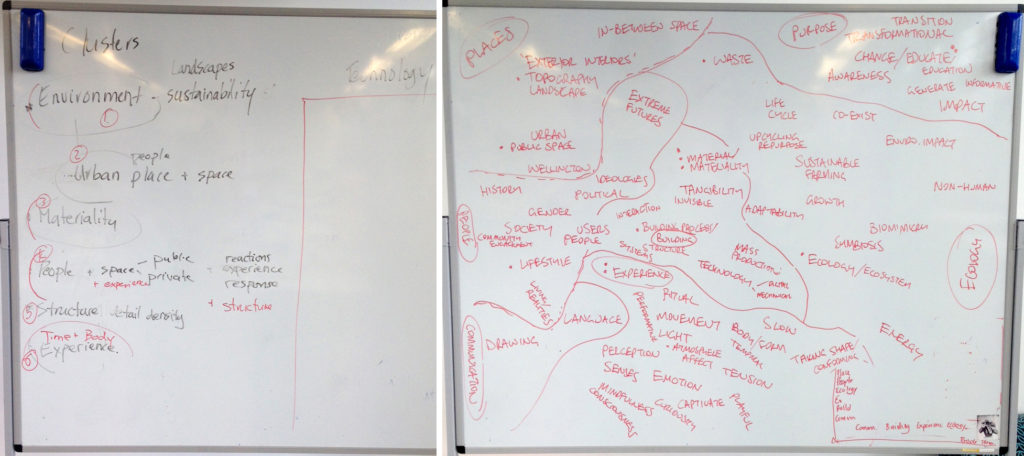
Whiteboard from Friday 3 March 2017: emerging concerns and clusters
For Monday:
- make sure you have set up your blog and fill out blog form
- reflect on today’s session and identify three key words that capture the concerns of your research as it currently sits (these are just a starting point and will change and evolve!)
- post your reflection on your blog (#reflection) – focus on where you feel your research might be situated – this is to give you a starting point for finding communities of discourse and practice
- start gathering key readings/resources and add them to the shared research cluster document
- bring something that you have made or written in response to your initial research ideas/clusters, as a conversation starter for the next session
Last modified: March 4, 2018